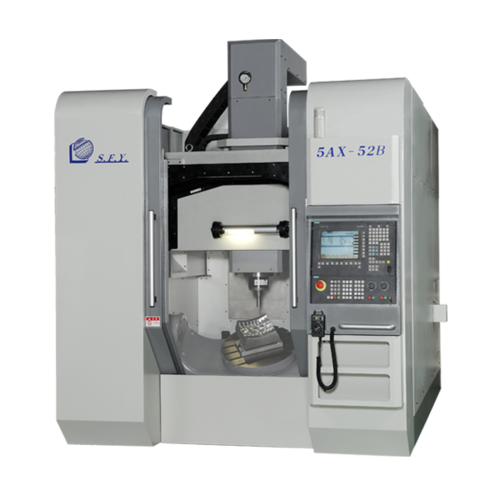
Done in a Single Setup! Master Complex Freeform Surfaces for Aerospace & High-End Medical Applications.
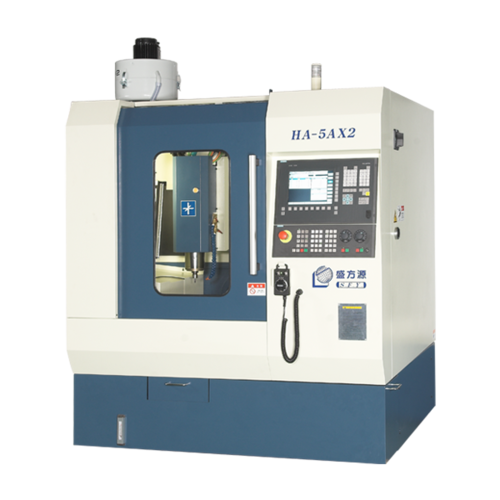
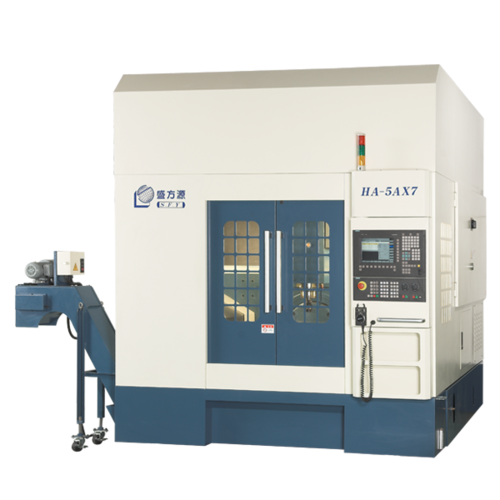
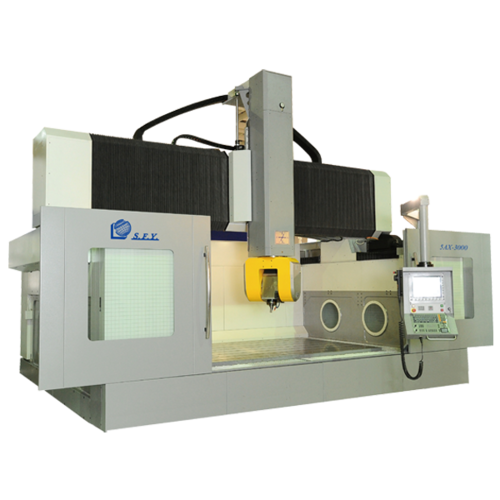
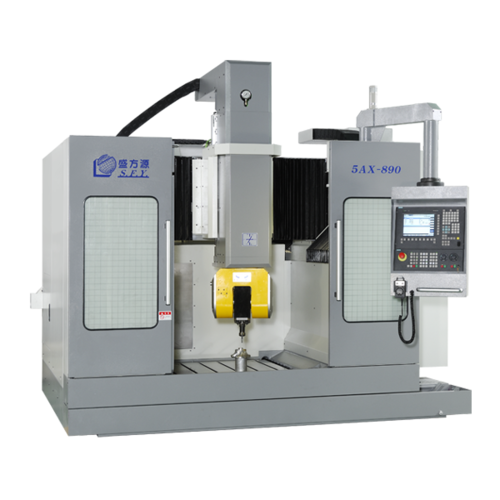
SFY 5-Axis CNC: Technology & Application Snapshot
- Core Technology: Continuous Simultaneous 5-Axis Interpolation (Not 3+2 positioning).
- Primary Advantage: Ultimate Single-Setup Efficiency to eliminate stack-up tolerances.
- Key Applications: Turbine blades, LEO satellite components, Blisks, and Orthopedic implants.
- Materials Mastered: High-performance alloys including Titanium and Nickel-based superalloys.
SFY CNC is an industry-recognized leader in high-precision 5-axis machining centers. Our 5-axis solutions are engineered specifically for extreme workpieces that demand the highest levels of "geometric complexity" and "absolute precision." By breaking through the limitations of traditional 3-axis machining and enabling continuous simultaneous cutting across five axes, we empower advanced manufacturing with unparalleled multi-sided machining capabilities.
Core Advantages of SFY Simultaneous 5-Axis Technology
Our 5-axis architecture is designed to eliminate stack-up tolerances and maximize throughput for the most demanding geometries:
Ultimate Single Setup Efficiency
Complete all-around machining of complex polyhedrons with just one clamping. This drastically reduces loading time and completely eliminates human positioning errors caused by multiple workpiece flips, significantly boosting yield rates.
Uncompromised Tool Accessibility & Rigidity
Agile multi-axis tilting allows toolpaths to utilize shorter, highly rigid cutting tools. Even when machining deep cavities or steep draft angles, it effectively dampens tool deflection and chatter, drastically extending tool life.
Flawless Freeform Surface Finishing
Maintain optimal cutting feed rates and continuous tool engagement to achieve exceptional surface roughness (Ra). For complex 3D profiles, this often eliminates the need for time-consuming secondary hand-polishing operations.
Dedicated Applications: Taking on the Pinnacle of Part Precision
We purposefully position our 5-axis machining centers for cutting-edge industries that require the flawless execution of "complex spatial curves" and the machining of "high-performance alloys":
- Low Earth Orbit (LEO): Tackle the space industry's rigorous demands for extreme lightweighting and zero-fault tolerance. Perfectly overcome the challenges of thin-wall titanium machining for satellite antennas and thrusters.
- Aerospace & Aviation: The absolute first choice for machining critical aerodynamic profiles. We specialize in turbine blades, integrally bladed rotors (Blisks), complex impellers, and highly contoured structural nodes.
- High-End Medical Implants: Effortlessly realize complex, organic shapes that conform to human ergonomics. It's the perfect solution for biocompatible orthopedic implants, artificial joints, and precision surgical instruments.
- Precision Rotors & Advanced Prototyping: Engineered to provide the most efficient rapid manufacturing capabilities for complex industrial rotors, multi-blade propellers, and precision engineering prototypes.
Frequently Asked Questions About Simultaneous 5-Axis
What is the main difference between Simultaneous 5-Axis and 3+2 Axis (5-Sided Machining)?
Simultaneous 5-axis can interpolate all five coordinate axes at the same time during cutting, making it the only viable solution for machining "continuous complex surfaces" like turbine blades. In contrast, 3+2 axis locks the rotary axes into a specific position before cutting begins, making it better suited for flat or angled faces on multi-sided parts.
How does adopting a 5-axis machine practically improve production yield?
The biggest advantage lies in the "Single Setup". Complex workpieces only need to be fixtured once to complete all machining operations. This completely eliminates the stack-up tolerances caused by the repeated manual flipping and repositioning required on traditional 3-axis machines, guaranteeing absolute geometric accuracy.